


While it may not be for everyone, the lessons off-grid living provides means there’s something for everyone. Whether energy conservation, water collection and use, environmental impact or a reduction of our consumption, there’s reason to pay attention. A recently completed home in the bush, not far from Canberra presents a few more arguments for the case of off-grid living.
It's hard to miss Ochre House, clad in corrugated Colourbond Terrain, the ochre brown, material is the defining element of this project. The pitched roof, veranda and adjoining buildings do little to dispel any notions of Australian architectural vernacular either, conjuring up the saltbox shearing sheds once so prevalent in the region. The bold, almost ascetic form of the exterior allows it to become part of the landscape, its colour reflecting the natural hues, indigenous pigments and native flora of its bush setting.
Ochre House was designed by Canberra studio MYMYMY to be complimentary and sympathetic to the Australia landscape, rather than attempting to blend in or hide the structure.

“It’s a brave colour” laughs Mark Brook, co-director of MYMYMY, “and the thing that I think that made it feel like a brave decision at the time - I can't imagine any other way now - is why do we continually make very similar decisions to other people? Most people when they think of that connection to landscape, they kind of go down the Glen Murcutt path, which is, and this is not a criticism of that decision at all - we definitely explored it – but there are other alternatives to try.”
“Look at what Australian flora and fauna looks like, like banksia or kangaroo paw, there's a lot of examples of flowers being these tones. And obviously there are indigenous pigments and those kinds of earth tones. So, rather than trying to blend in, this is complimentary, it’s sympathetic, it stands out but feels appropriate.”
Internally, the philosophy of paying respect to the surrounding environment continues. The concept isn’t to blend, but to pay homage to its surrounds and the results speak volumes; Ochre House feels crafted. The quiet variations of Iron Bark – an Australian native - patchwork their way through the home as a connector. Largely untreated to reflect their true nature, they have only oil on them to protect and retain the honest, matte finish.

Each room takes on a theme, while remaining a consistent whole, paying its compliment to nature Brook proudly speaks to. In both bathrooms – one with green tones, the other red, each speak to their views in their own language. Laminex Kalamata goes all-in on the cabinetry of the red toned bathroom, riffing with the terracotta basin and red clay tiles of the wet areas. It anchors the rooms, without being heavy or overwrought.
“We obviously do a lot of colourful projects,” says Brook, “so having a wide range of colours to select from allows us to choose the tones that are going to be sympathetic to the environment and other decisions we’ve already made.”
“Kalamata is a favourite, I have to stop myself form using it so much, and Olivine is such a neutral, beautiful soft colour, soothing” explains Brook on his decisions for Ochre House. “Choosing Laminex is about giving ourselves that colour range with the robustness and durability, letting us focus on designing things for longevity.”

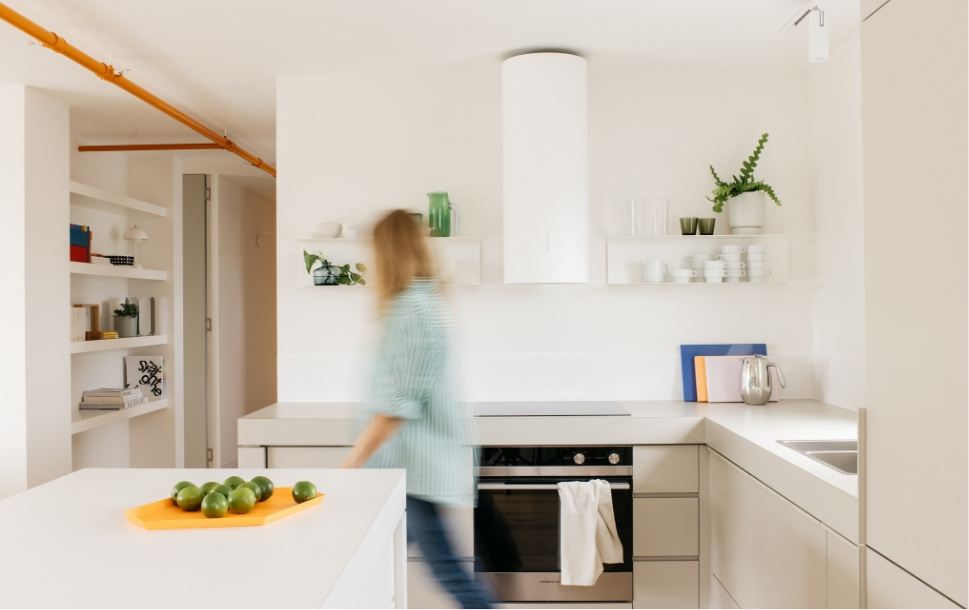
Elsewhere, MYMYMY has added Laminex that continues to explore and illuminate the Australian native landscape with subtle differences. Laminex Spinifex in the kitchen uses a green-blue and grey base to play with the gentle tones of gum trees and nocturnal fauna, while Laminex Peruvian Clay in the bedroom joinery and entrance cabinet make a connection to indigenous art and culture and the earth the binds.
As Brook puts it, Ochre House is “an expression of what it means to live well in this environment… prioritising quality over quantity.” An off-grid house is still a house, yet the decision to live this way arguably brings with it a few more considerations – one does not simply walk into off-grid living without pondering the consequences of such a lifestyle. Every choice, material or supplier, energy requirement or design spec feeds back to the central principle; how will this impact the environment and therefore my way of life?

The beauty of Ochre House is that it does these things without tripping over itself. The solution is clear and present. It’s in the water tanks, solar panels and bushfire ready cladding, but ultimately this is a beautiful home fully encapsulating what it means to live connected to the land.
If we build things to last, avoid planned obsolescence and unrepairable products, we change our relationship with consumption and waste, values Laminex holds dearly – not just at the consumer end, but in production and development, through to end of life and beyond.

What better metaphor than a sliding door to finish then?
“[The sliding door] is probably one of my favourite things in the whole project. The stain glass windows are about creating a connection to the environment, making you think about what the sunlight is doing today; is it a demure, overcast day? Is it bright? What time of day is it? The stain glass makes you focus on that, maybe more so than a clear window would,” ponders Brook.
Like becoming a minimalist, there’s always the extreme; those that make do with a single cup, a pair of pants, a chair and bed that doubles as a sofa, but the takeaway is that we can and will survive with less. The conclusion is inevitably less is more and done right, even incrementally, we can live a life of design and style albeit with less impact.
Take another look at Ochre House.




Credits:
Architecture: MYMYMY Architecture
Builder: Megaflora Goup
Joiner: Created Bespoke Joinery
Photography: Anne Stroud
You might also like